Introduction
Elephants are among the most intelligent, emotional, and majestic creatures on Earth. They have fascinated humans for centuries with their immense size, complex social structures, and remarkable memory. However, not all elephants are the same. The two main species—Asian elephants and African elephants—differ significantly in appearance, behavior, habitat, and lifestyle. Understanding the contrast between Asian elephants vs African elephants helps us appreciate their uniqueness and the importance of conserving both.
This in-depth article explores every major difference between Asian and African elephants, from physical features to social behavior, diet, and conservation status.
Overview of Asian Elephants and African Elephants
Asian elephants (Elephas maximus) and African elephants (Loxodonta africana and Loxodonta cyclotis) belong to the same family but evolved in different environments. African elephants are further divided into savanna elephants and forest elephants, while Asian elephants are a single species with several subspecies.
Although they share common traits such as trunks, tusks, and high intelligence, their differences are clearly visible and biologically significant.
Physical Size and Body Structure
One of the most noticeable differences in Asian elephants vs African elephants is size.
African elephants are the largest land animals in the world. Adult males can weigh up to 6,000 kilograms and stand over 3.5 meters tall at the shoulder. Asian elephants are slightly smaller, with adult males typically weighing between 3,000 to 5,000 kilograms and standing around 2.7 to 3 meters tall.
African elephants have a more robust and taller body structure, while Asian elephants appear more compact and rounded. This difference in size is largely due to environmental adaptation and food availability.
Ears: A Defining Feature
The ears are one of the easiest ways to distinguish Asian elephants from African elephants.
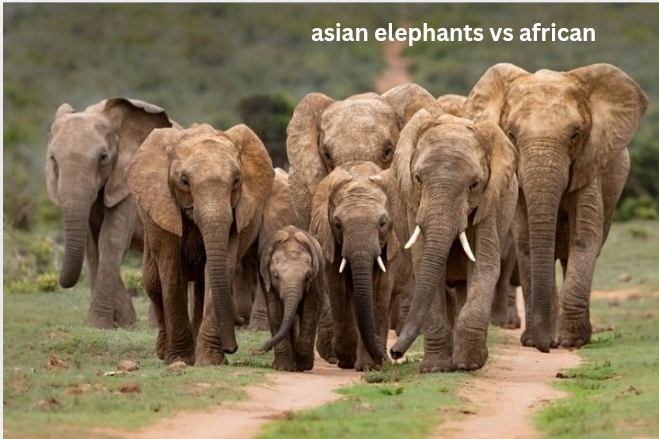
African elephants have extremely large ears shaped somewhat like the African continent. These massive ears help regulate body temperature by releasing heat, which is essential in the hot African climate.
Asian elephants, on the other hand, have smaller, rounded ears. Because many Asian elephants live in forests and slightly cooler regions, they do not require such large ears for temperature control.
Head Shape and Forehead
Another clear difference in Asian elephants vs African elephants is the shape of the head.
Asian elephants have a distinctive twin-domed head with a noticeable indentation in the middle of the forehead. African elephants have a single, rounded dome without a central indentation.
This skull structure difference is not just cosmetic—it reflects variations in muscle attachment and feeding behavior.
Tusks: Size and Presence
Tusks are another key point of comparison.
In African elephants, both males and females usually have tusks, although females tend to have smaller ones. These tusks are used for digging, stripping bark from trees, defense, and social interactions.
In Asian elephants, tusks are mostly found in males. Many Asian elephant males are tuskless or have very small tusks, known as “tushes.” Female Asian elephants rarely have tusks at all. This difference has significant implications for survival, especially due to poaching.
Trunk Differences
The elephant’s trunk is one of the most versatile tools in the animal kingdom.
African elephants have two finger-like extensions at the tip of their trunk—one on the top and one on the bottom. This allows for a strong grip, making it easier to pick up small objects.
Asian elephants have only one finger-like extension at the tip of the trunk. While still highly functional, this makes their grip slightly different, relying more on wrapping and pressing objects against surfaces.
Skin Texture and Wrinkles
Skin texture is another area where Asian elephants vs African elephants differ.
African elephants have deeply wrinkled skin, which helps retain moisture and mud, keeping them cool in hot environments. Asian elephants have smoother skin with fewer wrinkles, as their habitats are often more forested and humid.
Both species use mud and water to protect their skin from sunburn and parasites, but African elephants rely more heavily on this behavior.
Habitat and Geographic Range
African elephants are found across sub-Saharan Africa, inhabiting savannas, grasslands, deserts, and forests. Their wide range allows them to adapt to various ecosystems.
Asian elephants are primarily found in South and Southeast Asia, including India, Sri Lanka, Thailand, and parts of Indonesia. They prefer dense forests, grasslands, and areas near water sources.
Habitat differences play a major role in shaping the behavior and physical traits of both species.
Diet and Feeding Habits
Both Asian and African elephants are herbivores, but their diets vary based on habitat.
African elephants consume a wide variety of vegetation, including grasses, leaves, bark, fruits, and roots. They can eat up to 300 kilograms of food per day.
Asian elephants rely more on grasses, bamboo, palm leaves, and cultivated crops. This sometimes brings them into conflict with humans, especially in agricultural areas.
Their feeding habits significantly impact ecosystems, making elephants known as “ecosystem engineers.”
Social Structure and Behavior
Elephants are highly social animals, but there are differences in their social organization.
Both species live in matriarchal family groups led by the oldest and most experienced female. These groups consist of related females and their young.
African elephant herds tend to be larger and more loosely structured, sometimes forming massive groups during migration. Asian elephant herds are generally smaller and more tightly knit, especially in forested environments.
Adult males of both species usually live solitary lives or form temporary bachelor groups.
Intelligence and Communication
In the comparison of Asian elephants vs African elephants, intelligence is a shared strength.
Both species exhibit remarkable cognitive abilities, including problem-solving, empathy, grief, and self-awareness. Elephants are known to recognize themselves in mirrors and remember individuals for decades.
Communication includes vocalizations, body language, and low-frequency sounds called infrasound, which can travel long distances. African elephants are particularly known for using infrasound to communicate across vast open landscapes.
Interaction with Humans
Asian elephants have a long history of domestication and working alongside humans. They have been used for transportation, logging, ceremonies, and warfare for thousands of years.
African elephants, due to their size and temperament, have rarely been domesticated. Human interaction with African elephants has historically been more distant and often conflict-driven.
This difference has shaped human perception and cultural significance of elephants across regions.
Conservation Status and Threats
Both Asian and African elephants face serious threats, but the challenges differ.
African elephants are primarily threatened by poaching for ivory and habitat loss. Conservation efforts have helped stabilize populations in some regions, but illegal ivory trade remains a major issue.
Asian elephants face habitat fragmentation, human-elephant conflict, and limited genetic diversity. Rapid urbanization and agricultural expansion have drastically reduced their natural habitats.
Asian elephants are classified as Endangered, while African elephants are listed as Vulnerable or Endangered depending on the subspecies.
Lifespan and Reproduction
Both species have long lifespans, typically living 60 to 70 years in the wild.
Gestation lasts around 22 months—the longest of any land animal. Calves are highly dependent on their mothers and other females in the herd for several years.
Reproductive rates are slow, making population recovery difficult when numbers decline.
Cultural and Symbolic Importance
Asian elephants hold deep cultural and religious significance, especially in Hinduism and Buddhism. They are symbols of wisdom, strength, and good fortune.
African elephants are powerful symbols of strength, leadership, and memory in many African cultures. They also play a vital role in wildlife tourism, contributing to local economies.
Key Differences Summary
When comparing Asian elephants vs African elephants, the main differences include:
- Size: African elephants are larger
- Ears: African elephants have bigger ears
- Tusks: More common in African elephants
- Head shape: Twin-domed in Asian elephants
- Habitat: Asia vs Africa
- Human interaction: Domestication vs wild coexistence
Despite these differences, both species share intelligence, emotional depth, and ecological importance.
Conclusion: Asian Elephants vs African Elephants
The comparison of Asian elephants vs African elephants highlights how evolution shapes species based on environment, climate, and survival needs. While African elephants dominate open landscapes with their massive size and large ears, Asian elephants thrive in forested regions with their compact build and close social bonds.
Both species are irreplaceable treasures of our planet. Protecting them requires global awareness, habitat conservation, and ethical coexistence with humans. By understanding their differences and similarities, we can better appreciate these gentle giants and support efforts to ensure their survival for generations to come.